
Post-Oscars, there’s a slump. The big offerings in cinemas over Easter are, for families, The Magic Faraway Tree, an adaptation of Enid Blyton’s children’s series starring Andrew Garfield and Claire Foy, and, for the dating pool, there is The Drama, a romcom about premarital cock-ups between a British museum director, Robert Pattinson, and a Baton Rouge bookshop assistant, Zendaya. Unaccountably, no one has been allowed to see either of these releases in advance.
Intelligent life resumes after Easter. Father Mother Sister Brother, Jim Jarmusch’s 14th feature, won the Golden Lion, the top prize at the Venice Film Festival, last year. It’s modest, funny and touching: an anthology film about incomprehension between parents and children, in three sections.
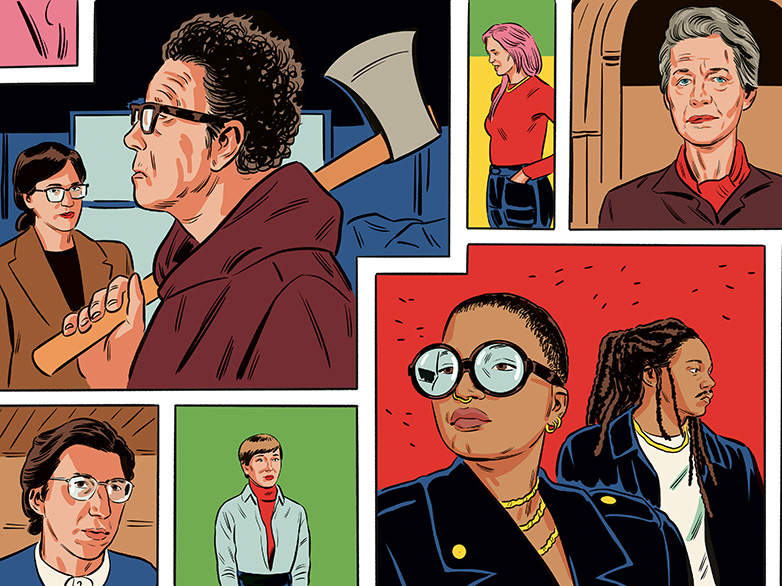
The mood is set by a little abstract episode of what seems to be flickering film stock and drifting music. Then we’re in a car, driving through a snowy American landscape, with siblings Jeff (Adam Driver, playing it straight) and Emily (Mayim Bialik, beadily prim). They are, we realise, going to see their strange father for the first time in two years. “How does Daddy survive exactly?” Emily asks. “I’m not completely sure,” says Jeff, but then concedes he has been sending him money to cope with various supposed emergencies with his house – the well, the septic, the wall…
They arrive at what looks like a wrecky clapboard house in “Nowheresville”. After much knocking, Daddy appears at the door, emaciated, raggedy and thoroughly awkward. As soon as he speaks, you realise it’s Tom Waits, Jarmusch’s long-term collaborator. That gravelly voice is irresistible.

The scenes that follow had me convulsed. “Make yourselves at home” says Daddy, an impossible imperative, the place being a tip. “Can I get you anything? Some water?” He offers ice and Jeff declines, but Emily insists. “Ice coming up,” rumbles Daddy. “Wish I had some lemon or something to go with it…”
To Emily’s annoyance, Jeff has brought him a box of carefully chosen groceries. “Real quality here,” he observes, poking through it. His offspring have no idea who Daddy is at all. He has surprising books on his shelves – Mandelstam, Diogenes, Wilhelm Reich. “A nice watch, Daddy,” Emily notices with surprise. “Is that a Rolex?” A Chinese replica, he claims. They ask if he can afford heating and he nearly kills Jeff as he demonstrates with his axe how he chops his wood. How is his health in general, they enquire, as children must of their elderly parents. Any recent episodes? Is he taking any medication? “No heroin, no cocaine, no fentanyl, no LSD, no goofballs, no horse tranquillisers,” he alarmingly assures them. “I feel good.”
Not being able to think of anything more to say, they stand around, embarrassed, Jeff slipping him a roll of notes. “Glad we saw him – sort of,” they agree, driving away. Daddy, meanwhile, is fixing up a date – “The usual booth? Twenty minutes?” – before heading off in a Beemer he’s hidden round the back. This whole episode is an absolute treat. It’s worth the price of admission alone to see Waits again, after his great turns in The Ballad of Buster Scruggs and Licorice Pizza.
Mother, though, is equally well cast. Charlotte Rampling is marvellously icy as a rich romantic novelist who won’t talk about her books, living in a pristine mansion in Dublin, serving a tyrannically ornate tea to her two grown-up daughters, both of them equally alien to her in different ways, Timothea (Cate Blanchett) being a mousy drudge, Lilith (Vicky Krieps) a punky chancer with pink hair.
Sister Brother distances the generations further. Loving twins Skye (Indya Moore) and Billy (Luka Sabbat) meet in Paris to visit for the last time the emptied flat of their stylish, bohemian parents who have died in a mysterious small-plane crash in the Azores. Sifting through their IDs and certificates, the twins realise they hardly knew them.
All three parts have similar themes, from Rolexes to glasses of water to the phrase “Bob’s your uncle”. Jarmusch has adopted the PG Wodehouse strategy here and made it a virtue. (When a critic complained that a novel had contained all the old Wodehouse characters under different names, Wodehouse observed he had “out-generalled the man this time” by putting in all the old Wodehouse characters under the same names: “Pretty silly it will make him feel, I rather fancy.”) And, just like Wodehouse, Father Mother Sister Brother is pure pleasure.
“Father Mother Sister Brother” is out on 10 April
[Further reading: Tucker Carlson’s annunciation]
Content from our partners


Related


This article appears in the 25 Mar 2026 issue of the New Statesman, Easter Special
Join the debate
Subscribe here to comment